March 2, 2012

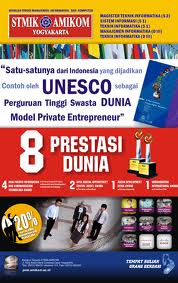
STMIK Amikom Yogyakarta cite this as a example by Unesco

5 komentar

Visit link AMIKOM :  http://www.amikom.ac.id 
STMIK Amikom Yogyakarta cite this as a example by Unesco


STMIK Amikom Yogyakarta as one private university in Indonesia has been paralleled by a variety of world-class universities by the UNESCO. The UN Board of Education set a few colleges of many of the world as a demonstration model for other universities. This example is the classification of higher education financing model is categorized in the UNESCO report, namely "A New Dynamics Private Higher Education".

   
No end of 2009 United Nations Educational, Scientific and Cultural Organization (UNESCO) published a report, "A New Dynamics: Private Higher Education". In Chapter Public-Private Partnerships Best Featured 8 PTS world; one from Yogyakarta Indonesia, namely the College of Informatics and Computer Management (STMIK) Amikom Yogyakarta.
Eight PTS is more is as follows: Shantou University (China), Harvard University (USA), Mulungushi University (Zambia), The Asian University for Women (Ow) (Bangladesh), STMIK Amikom yogyakarta (Indonesia), University of Phoenix (USA) , University of Hong Kong (China) and Creativie Linkokwing University of Technology (Malaysia).

     
Commenting on the report "A New Dynamics Private Higher Education", Prof. Ki Supriyoko MPd SDU, as director of the Graduate UST Yogyakarta, write an opinion paper published in the 23/02/2010 edition of People's Sovereignty Yogyakarta. The core text is STMIK AMIKOM Yogyakarta became the world's best private universities in terms of financial independence, because it does not get sepersenpun  STMIK AMIKOM  government assistance. So 100 percent of the funding comes from the creativity of students and managers.
     
Of course, Prof. Ki Supriyoko firm, was named the college pilot model in the world stage is something you are proud. It also proves that AMIKOM been paralleled by a variety of world-class universities by the UNESCO.
     
AMIKOM also been proven that private colleges will not lose either in terms of academic achievement and in terms of student creativity.When in reality many (faculty and students) PTS who received assistance from the government would need to be aware that assistance is provided by selectively-prestatif. Selective means that aid is not granted to all private universities, while it only meant PTS prestatif achievers are given financial assistance by the government. Although many private universities receive financial assistance from the government but still more that PTS did
not get it. Those were not a barrier to achievement. STMIK Amikom already proved, with the independence agency may be the best private universities in the world. Starting from a rented building for the college has now been accomplished in the world.

     
For achievement, and all things associated with STMIK AMIKOM YOGYAKARTA can be viewed directly on the website

http://www.amikom.ac.id


Read more...

Bunaken National Park: Life Under the Sea Amazing and very beautiful

0 komentar
Indeed, the beauty of the Indonesian island of Bunaken Island is very much an example of 8 km ² island, part of the Bunaken National Marine Park. Bunaken is located at the northern tip of Sulawesi island, Indonesia. It belongs administratively to the city of Manado. Scuba diving attracts many visitors to the island.
the beauty of the reefs in Bunaken also makes visitors come to this island. This marine park has marine biodiversity among the highest in the world. Bunaken marine park has a 20 point dive (dive spot) with varying depths of up to 1344 meters. Of the 20 point dive, dive 12 points of which are located around Bunaken Island. Twelve-point diving is the most frequently visited by divers and lovers of the beauty of the underwater scenery.

Bunaken National Park extends over an area of ​​890.65 km ² which is only 3% of terrestrial, including the island of Bunaken and Manado Tua island, Mantehage, Nain and Siladen.
Waters of Bunaken National Marine Park of up to 1566 m in the Bay of Manado, with temperatures ranging between 27-29 ° C. It has a high diversity - corals, fish, echinoderms or sponges. Specifically, 7 of 8 types of giant clams that occur in the world, occur in Bunaken. It also claims to have seven times more genera of coral than Hawaii, and has more than 70% of all fish species known from the Indo-West Pacific.


Read more...

Yogyakarta : Historic site of the Temple of Ancient History, Tradition, Culture

0 komentar
YOGYAKARTA (often also called Jogja, Yogyakarta or Jogja) is located in central Java - Indonesia. According to the history of thousand years ago, New York became the center of the ancient Mataram kingdom prosperous and civilized high. This kingdom built Borobudur Buddhist temple which is the largest in the world, 300 years before Angkor Wat in Cambodia. Some other relics are Prambanan, Ratu Boko Palace, and dozens of other temples scattered throughout Yogyakarta.
However, due to some mysterious reason, the Ancient Mataram Kingdom central government moved to East Java in the 10th century. Magnificent temples abandoned and partly buried by the eruption of Mount Merapi material. Slowly, the Yogyakarta area back into the thick forest.

Six hundred years later, Panembahan Senopati establish Islamic Mataram kingdom in the region. Once again, New York to witness the human history of the great Empire which ruled the island of Java and its surroundings. Islamic Mataram kingdom which left traces of the ruins of the castle and royal tombs in the town which was recently recognized as the silver center in Yogyakarta.
And Yogyakarta is now a 'Special Region of Yogyakarta (DIY)' and is the second oldest provincial After 'East of Java'. This province has a special status or autonomy. This status is a legacy from the days before independence. Sultanate of Yogyakarta and Paku Alaman Duchy, as the embryo or the origin of DIY, has status as a "vassal kingdom / State / Dependent state" A lot of places in Yogyakarta To see historical places and places such as shopping c
enters Malioboro


Read more...